
Survey #70: Senior Chief Special Warfare Operator, Kristin Beck
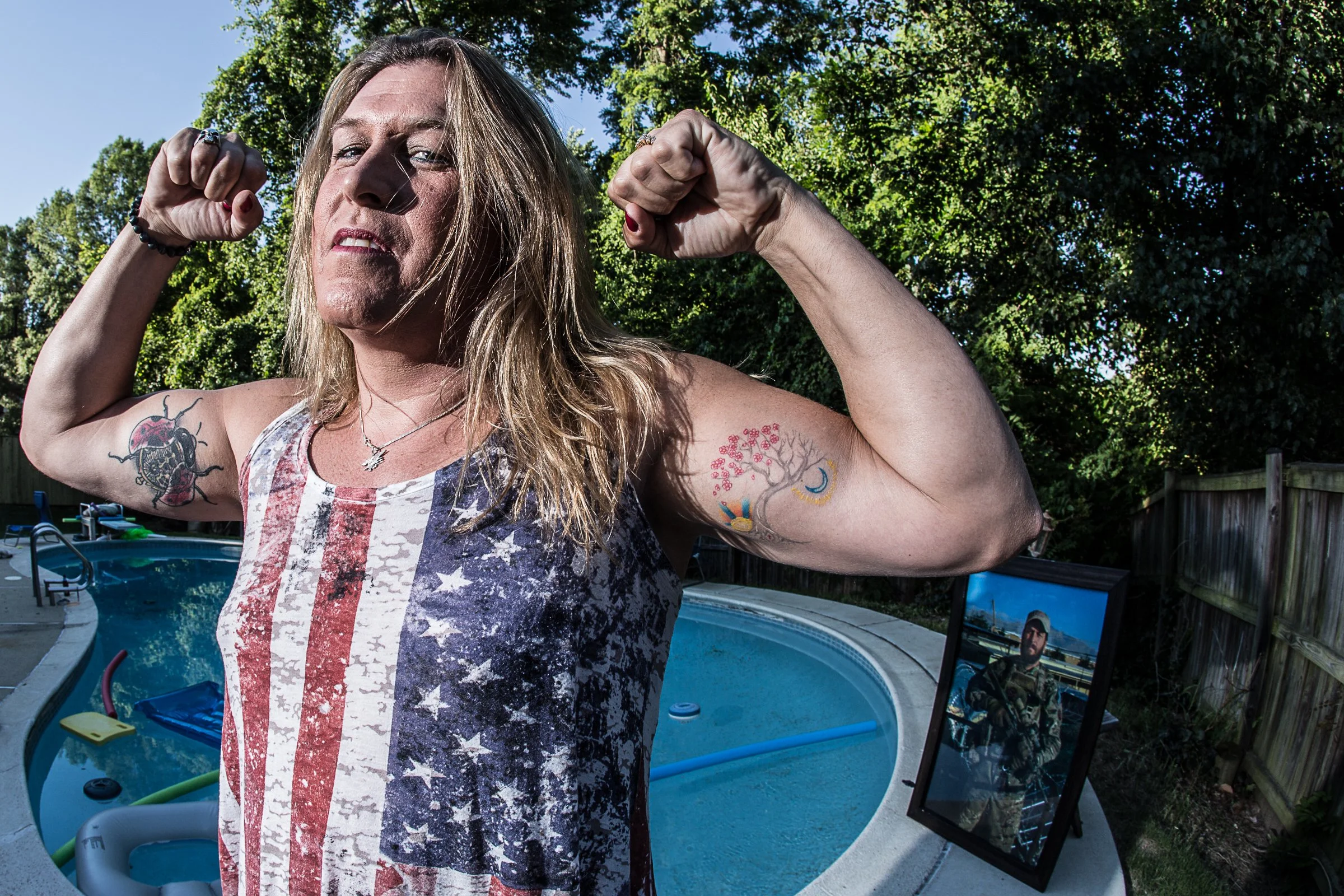
Kristin Beck
Survey #70 | Senior Chief Petty Officer (E-8), United States Navy (Retired)
Kristin Beck spent twenty years as a United States Navy SEAL, serving in one of the military's most demanding special operations communities. She became a senior chief petty officer, led specialized missions, developed military technologies, and deployed to war zones. Her career required exceptional discipline, physical endurance, technical skill, and the ability to make decisions under pressure. Yet throughout those years, she was also concealing a fundamental part of herself. When she retired in 2011 and publicly came out as transgender in 2013, the transition was not simply a change in how she presented herself to the world. It was the beginning of an effort to bring together parts of her life that she had spent decades keeping separate.
Beck grew up on a farm during the 1970s, in a family with a strong tradition of public service. Relatives had served as teachers, firefighters, police officers, politicians, and members of the military. When wars began, people in her family volunteered or continued their service. She inherited a belief that some people have a responsibility to protect others, an idea she described through the image of the sheepdog standing between vulnerable people and those who might harm them. She saw herself as someone willing to stand guard, defend freedom, and protect the rights of others. That sense of responsibility would remain central to her identity long after she left the military.
Growing up in a rural environment, Beck had little access to information about gender identity. There was no internet, and the subject of transgender people was not part of her childhood understanding of the world. Nevertheless, she recognized early that something about her was different. She recalled playing with her sisters and putting on a ballet outfit belonging to one of them. They were jumping on a bed, laughing and enjoying themselves, when her father entered the room. His angry reaction taught her that this expression of herself was unacceptable. The experience became an early lesson in concealment.
For years afterward, Beck tried to suppress her feelings. She described repeatedly attempting to eliminate that part of herself, only to find that it remained. She could change her clothing, behavior, and outward appearance, but she could not change what she understood about herself. The effort became a continuing internal struggle. She learned to build layers of behavior around her identity, presenting the version of herself that others expected while keeping private the feelings she believed could not safely be expressed.
When Iraq invaded Kuwait in 1990 and the United States began preparing for the Persian Gulf War, Beck felt called to serve. She joined the military during the period of Desert Shield and Desert Storm, following the example of generations of family members who had responded to national emergencies. The Navy SEAL community offered a demanding environment in which discipline, determination, and achievement were essential. Beck embraced those expectations. She trained, competed, and worked to become the strongest and most capable operator she could be.
Looking back, she believed that her determination to excel was influenced in part by the identity she was hiding. She pushed herself physically and professionally, seeking validation through achievement. Being a successful SEAL, an exceptional shooter, a fast runner, or the strongest person in a group became ways of demonstrating that she belonged. The more thoroughly she embodied the outward image of a hardened special operations warrior, the more effectively she believed she could conceal the feelings that did not fit that image. Achievement brought genuine satisfaction, but it also became part of the protective structure she had built around herself.
Beck's work in the SEAL teams extended far beyond the physical demands commonly associated with special operations. She specialized in intelligence gathering, long-range reconnaissance, surveillance, and the development and use of technology. She worked with miniature cameras, audio devices, and other equipment designed to collect information in difficult environments. Her assignments included training in specialized methods of access and observation, as well as the broader tactical skills expected of a SEAL. She was interested in how technology could make complicated operations more effective and how careful planning could reduce unnecessary risk.
She was also mechanically inclined. Beck worked on outboard motors, motorcycles, and other equipment, and she enjoyed building Harley-Davidsons in her personal time. Her interest in engineering carried into military mission planning, where she became skilled at designing computer interfaces and finding ways to simplify complicated procedures. She believed that making a system easy to understand and use required a particular kind of intelligence. Complexity was often unavoidable, but she saw value in reducing it to something that people could operate reliably under pressure.
Her responsibilities grew as she advanced through the ranks. Beck became a military free-fall jumpmaster, responsible for coordinating parachute operations, overseeing inspections, and determining the conditions under which personnel would exit aircraft. She also served as a diving supervisor, organizing and overseeing underwater operations. She described commanding ground assault elements on some missions and taking responsibility for aspects of helicopter operations. These roles required more than technical competence. They demanded the judgment to recognize danger, the confidence to make decisions, and the ability to lead people whose lives could depend on those decisions.
Over the course of her career, Beck served as a chief petty officer with a platoon and later as a senior chief within a task unit. Her leadership experience was built around the expectation that a team should understand its mission and work toward a common objective. She valued people who arrived prepared, accepted responsibility, and did what needed to be done without requiring constant encouragement. The military reinforced her belief that difficult tasks could be accomplished when capable people shared a clear purpose.
Her technical reputation eventually brought her to the attention of William Shepherd, a former astronaut who was working in the special operations community. Beck recalled receiving a call inviting her to join a science and technology effort associated with United States Special Operations Command in Tampa, Florida. She was so eager to accept the assignment that she moved and purchased a house before the necessary orders had been completed. When Shepherd learned that she had already relocated, he was surprised by how literally and quickly she had acted on the invitation. Beck remembered the incident with amusement. For her, being given a mission meant beginning the work immediately.
At Special Operations Command, Beck was asked to help establish specialized laboratories that could develop and adapt equipment for operational use. The assignment initially came with almost no resources. She recalled being told that there was no budget, no established team, and only six months to create a functioning capability and deploy it to Afghanistan. Rather than treating those limitations as reasons the project could not be done, she began assembling the people, funding, equipment, and training necessary to make it happen.
According to Beck's account, she secured approximately twelve million dollars in resources and organized a growing team of specialists. She developed training procedures, coordinated equipment, and helped establish several laboratories that were deployed to Afghanistan within the requested period. She described the program as a major success that continued expanding after her involvement. The experience illustrated the kind of work she found most rewarding: taking an idea that seemed impossible, identifying what was required, and building an organization capable of accomplishing it.
Beck's final deployment took her to Afghanistan in 2010. By then, she had accumulated two decades of military experience, including the physical and psychological effects of repeated demanding assignments. She described injuries, broken bones, surgeries, and the lasting consequences of incidents that included an explosion in 2008. Military service had given her a sense of purpose and achievement, but it had also taken a toll on her body. She was approaching retirement with both a distinguished professional record and significant challenges that would follow her into civilian life.
Her private struggle with gender identity had continued throughout her career. She married, but concealed her feelings from her wife, something she later recognized had caused difficulties in the relationship. She had tried to convince herself that military life, marriage, and the image she presented to others would allow her to leave those feelings behind. Instead, the need to conceal herself remained a source of pressure. Beck described it as adding layer upon layer of disguise until she sometimes felt she had lost sight of who she really was.
In 2008, while still serving, Beck began sharing her identity with members of her family. She recalled visiting her mother in Maryland after working at the Pentagon. Arriving in a suit and tie, she asked to change into something more comfortable. She returned wearing women's clothing, a wig, and makeup. Her mother's surprised reaction was not the response Beck had imagined, but the encounter marked an important moment. She had revealed a part of herself that had been hidden for most of her life. Over time, other family members also learned, although not everyone responded with the same degree of understanding.
As retirement approached, Beck began exploring how she wanted to live outside the military. In 2010, while still on active duty, she pierced her ears. On one occasion she forgot to remove the earrings before going to work. A colleague noticed and asked about them. Beck immediately took them out, worried that the incident might expose something she had spent years concealing. The colleague did not pursue the matter. She remembered the relief of realizing that he was willing to let the moment pass without further questions.
Halloween in 2010 provided another turning point. Beck went out in public presenting as a woman, taking advantage of a holiday when unusual clothing would attract less attention. She visited a gay bar, where she felt she could explore her identity with less fear of judgment. When she returned after Halloween, people recognized her and asked whether she was still dressing that way. Beck explained that this was how she intended to present herself and that her name was Kristin. Their acceptance surprised her. They did not demand an explanation or treat her identity as something extraordinary. They simply welcomed her back.
For someone who had spent so many years monitoring every aspect of her behavior, that response was profoundly different from what she had known. Beck discovered a community in which people could express themselves in ways that did not necessarily conform to conventional expectations. She appreciated the freedom to experiment, to be uncertain, and to change without having to defend every choice. The experience helped her recognize that she no longer needed to maintain the same rigid image she had developed during her military career.
Beck retired from the Navy in February 2011 as a senior chief petty officer, pay grade E-8. Retirement ended one demanding chapter of her life, but it also removed the structure that had organized her days for twenty years. She found the transition to civilian life difficult. The military had provided a clear hierarchy, established expectations, and a common mission. Outside that environment, people had different priorities, schedules, and ideas about what mattered. Beck discovered that the directness and urgency that had served her well in uniform did not always translate easily to civilian workplaces.
She described impatience as one of the most significant habits military service had left her with. In the SEAL teams, people were expected to arrive on time, understand their responsibilities, and complete assignments. In civilian organizations, she encountered situations where motivation, persuasion, and negotiation took much more time. She recognized that people outside the military were not necessarily wrong to approach work differently. They simply operated within a different structure, where individuals often pursued competing objectives rather than a single mission.
That realization forced Beck to reconsider her approach to leadership. She had spent years learning how to organize capable people around clearly defined goals. In civilian life, she needed to understand why people were moving in different directions before she could persuade them to work together. She compared the problem to an explosion sending objects outward in every direction. The challenge was not merely to issue instructions, but to identify common interests and help people move toward a shared purpose. Learning that kind of patience became part of her adjustment to life after military service.
At the same time, Beck was dealing with physical pain, emotional strain, and the uncertainty of her personal transition. She described taking prescribed pain medication for longstanding injuries and becoming concerned about her reliance on it. She also began drinking more heavily, sometimes using alcohol to help her sleep. She was divorced, struggling with family relationships, and uncertain about her professional future. The combination of military retirement, chronic pain, and the effort to understand her gender identity made the years immediately following retirement especially difficult.
Writing became one way of processing those experiences. Beck began drafting a book about her life, recording memories of military service and the personal struggles she had concealed. She hoped to explain the relationship between the outward identity she had maintained for decades and the person she was beginning to acknowledge. During this period, a friend introduced her to a psychologist because he was worried about her emotional well-being. Beck began discussing her experiences, including her military history and gender identity, with the psychologist.
The relationship later became a source of intense distress. Beck believed that the psychologist had taken advantage of her vulnerability and involved herself in the publication of Beck's life story through agreements Beck regretted signing. In the interview, Beck described the resulting disputes over control of her story as deeply damaging. These were her accounts of the relationship and its consequences, not independently established findings about the other person. What mattered to Beck was the feeling that she had lost authority over the story she was struggling to understand and tell for herself.
She described the emotional effects of those disputes in unusually personal terms. The conflict intensified her existing distress and contributed to a period when she felt overwhelmed. Beck recalled swimming far into the ocean one night while upset and after drinking, eventually recognizing the danger and turning back toward shore. She spoke about the incident as part of a larger struggle to regain control over her life. Her account revealed how difficult the period after retirement had become, despite the confidence and determination she had demonstrated throughout her military career.
In June 2013, Beck publicly came out as transgender in a nationally televised interview with Anderson Cooper. The appearance brought widespread attention to her life as a retired Navy SEAL and to the contrast between the identity she had presented during her military career and the one she was now openly acknowledging. She soon became involved in interviews, public appearances, and a documentary film, Lady Valor: The Kristin Beck Story. The film followed her experiences as she navigated life after military service and the public attention surrounding her transition.
The visibility was both an opportunity and a burden. Beck could speak to people who might never have considered the experiences of transgender veterans, but she also found that public interest often centered on simplified ideas about her identity. She was a retired Navy SEAL, a transgender woman, an engineer, a veteran dealing with injuries, and someone still trying to understand the direction of her life. She did not believe any single description captured all of those experiences. Public attention could make it difficult to retain the complexity of her own story.
Beck began speaking at colleges, universities, and other events, discussing military service, gender identity, and the importance of treating people fairly. She considered herself an activist, although she noted that public speaking did not necessarily provide a dependable income. Some appearances covered her expenses, while others cost her money. Her motivation was not simply financial. She wanted to challenge assumptions and encourage people to think more carefully about individuals whose lives did not fit familiar categories.
Her understanding of gender was particularly important to the way she described herself. Beck used the term two-spirit to express her desire to acknowledge both the masculine and feminine aspects of her experience. She did not want to erase the person who had served in the Navy or pretend that the photographs of her wearing a beard and military uniform represented someone else. Those years were part of her life, and she remained proud of what she had accomplished. At the same time, she wanted the freedom to express the parts of herself that she had long concealed.
Beck rejected the idea that her transition required her to disown her past. She understood that some transgender people wanted to move away from earlier identities, but that was not the path she described for herself. She wanted to bring together the qualities she associated with her years as a SEAL and those she was discovering through living openly as Kristin. Her transition, she explained, was not primarily about changing her body. It was an intellectual, emotional, and spiritual process of understanding how those different experiences could exist within one person.
The language she used was personal rather than a universal definition of transgender identity. She spoke about masculinity, femininity, spirit, and energy as ways of describing her own experience. She wanted people to consider whether the qualities they associated with gender were as fixed as they assumed. In her view, identity involved far more than appearance or anatomy. It included personality, judgment, emotional life, relationships, and the ways people understood themselves.
That perspective also shaped her feelings about military service. Beck did not regard her years as a SEAL as a false identity or an experience she wished to discard. She had genuinely valued the work, the people, and the responsibilities entrusted to her. She was proud of her technical accomplishments and her ability to lead demanding missions. Her criticism was directed at the pressure she had felt to conceal herself, not at the entire life she had built in uniform. The challenge after retirement was to recognize that the strength and discipline developed during those years could remain part of her without requiring the same secrecy.
Her story also raised questions about the relationship between achievement and self-worth. For much of her life, Beck had measured herself through physical performance, professional success, and the approval of others. The SEAL community rewarded exceptional effort, and she had learned to push herself harder whenever she felt uncertain. After retirement, she began to question whether she still needed to prove herself in those ways. She could be strong without always being the strongest, capable without constantly competing, and worthy of respect without maintaining the appearance others expected.
The process was neither simple nor complete when she gave her interview. Beck was still learning how to navigate civilian institutions, manage the consequences of her injuries, and build a life that allowed her to be more open about herself. She continued to believe that difficult problems could be solved through persistence and ingenuity, but she was also discovering that some problems required patience, trust, and a willingness to accept uncertainty. The skills that had carried her through twenty years of military service remained valuable, even as she learned that they could not resolve every personal challenge.
Kristin Beck's life cannot be understood only through her military achievements or only through her transition. Her story is about the relationship between the two. The discipline, determination, and technical imagination that made her a successful Navy SEAL were genuine parts of her character. So were the feelings she had concealed, the vulnerability she experienced after retirement, and the freedom she sought in living openly. Her effort was not to replace one life with another, but to recognize that all of those experiences belonged to her.
Through Conduct Becoming, Beck's portrait and testimony preserve a veteran's account of service, identity, and change. She served her country for twenty years, rose to the rank of senior chief petty officer, and accepted responsibilities that demanded exceptional skill and commitment. After leaving the Navy, she faced a different challenge: learning to live without the protective layers she had built around herself. Her story demonstrates that the courage required to serve in war and the courage required to live openly can take very different forms, yet both demand a willingness to confront fear and uncertainty.