
Survey #52: Lance Corporal, Tommy Hill
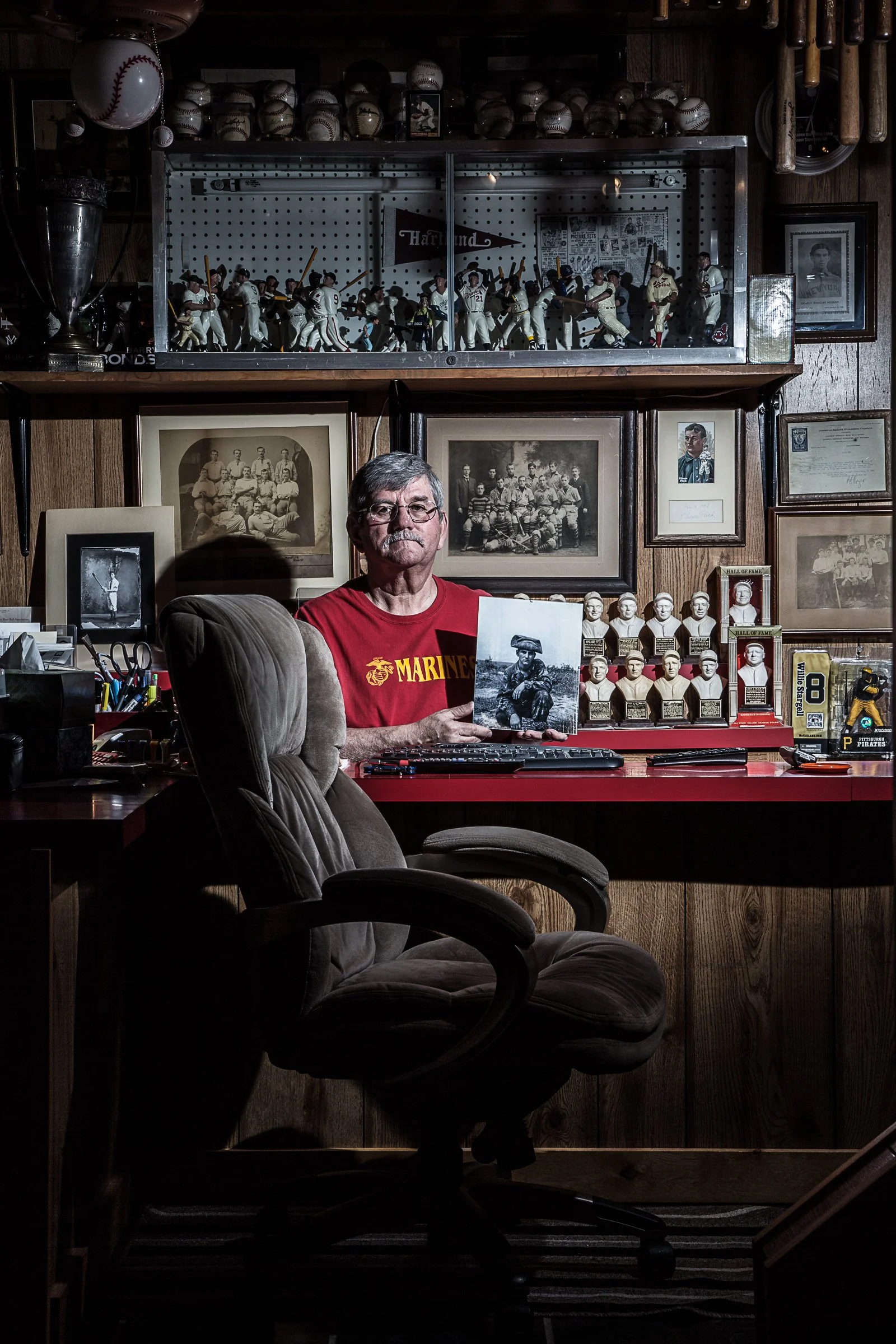
Tommy Hill
Survey #52 | Lance Corporal, United States Marine Corps | Vietnam War
Tommy Hill entered the United States Marine Corps in 1968, beginning a journey that would take him from his hometown of Upper Sandusky, Ohio, to the mountains and villages of South Vietnam. His decision to become a Marine was almost accidental. He and a friend had traveled to Mansfield, Ohio, intending to enlist in the Navy. Walking through the courthouse, they noticed a recruiting poster featuring a Marine in dress blues. Impressed by the uniform, they changed their minds and joined the Marines instead.
What began with that spontaneous decision would become one of the defining experiences of Hill's life.
At Parris Island, South Carolina, Hill suffered a stress fracture during recruit training. Despite severe pain, he continued through the physical requirements, eventually collapsing during a two-mile run. He was hospitalized, spent time in a wheelchair and on crutches, and eventually returned to training with another platoon. After completing boot camp and advanced infantry training, he was assigned to the infantry.
By then, his younger brother, who had enlisted at seventeen with their parents' permission, was already serving in Vietnam. Because the military was reluctant to send brothers into combat at the same time, Hill initially remained stateside. But he struggled with the knowledge that his younger brother was fighting overseas while he remained in California.
As the oldest brother, Hill felt he belonged there too. He volunteered for Vietnam, knowing what that decision would mean for his family.
Arriving in November 1968, Hill joined Golf Company, 2nd Battalion, 4th Marines, a unit known as the Magnificent Bastards. Operating near the Demilitarized Zone, he participated in combat operations that included Operation Scotland II and Operation Purple Martin. Much of his time was spent in the field, moving through dense vegetation, mountainous terrain, and areas where enemy forces could appear without warning.
The dangers were constant and often unpredictable. Hill remembers narrowly escaping an enemy mine concealed beneath vegetation while clearing a helicopter landing zone. On another occasion, his patrol narrowly avoided bombs dropped by an American aircraft operating with incorrect coordinates. He recalls lying motionless in the brush while enemy soldiers passed within a few feet of his listening post, fearful that even the sound of his radio might reveal their position.
But among his most enduring memories is the death of fellow Marine Ronnie Lee Eckenrode, whom Hill knew as “Echo.”
Eckenrode frequently volunteered to walk point, the exposed position at the front of a patrol. Hill had warned his friend about the danger. On March 19, 1969, Eckenrode was killed during an ambush that also claimed the lives of other Marines, including their platoon commander.
Hill remembers the anger and grief that followed. The loss made the uncertainty of his own survival impossible to ignore.
After several months in combat infantry, Hill volunteered for the Marine Corps' Combined Action Program, an approach to the war that placed small groups of Marines directly within Vietnamese communities. Rather than operating exclusively through large military formations, these units lived alongside villagers, worked with local defense forces, and attempted to build relationships with the people they were assigned to protect.
Hill served with the 1st Combined Action Group near Chu Lai, including Combined Action Platoon 127. His responsibilities changed considerably. During the day, he and other Marines helped villagers with agricultural work, construction, and community needs. They trained local Popular Forces soldiers and worked to prevent enemy infiltration. At night, they conducted patrols and established defensive positions.
For Hill, this work offered a different understanding of Vietnam.
He learned enough Vietnamese to communicate with local residents and developed relationships that went beyond his military assignment. He recalls how villagers initially feared the Marines, having heard frightening stories about them before their arrival. Over time, he believed that living and working together helped overcome some of that mistrust.
The unit's Navy corpsman also taught Hill basic medical procedures. Hill assisted in treating infections, administering medication, and caring for injured civilians. He remembers helping a young boy suffering from severe skin infections and the gratitude of the child's mother when his condition improved.
Other experiences were far more difficult. Hill assisted with casualties following an explosion among a gathering of villagers and helped evacuate a badly wounded local defense soldier while the unit's corpsman was away.
Among the people he remembers most clearly is a Vietnamese boy named Trung, who had suffered devastating burns when a flare ignited. Trung had previously traveled to a children's hospital in Colorado for medical treatment and spoke English. Hill's unit brought him into their compound to help with interpretation and everyday tasks, and the boy became a friend.
Their relationship eventually attracted the attention of a reporter from The Denver Post, who contacted Hill while researching Trung's life after his return to Vietnam. Hill shared what he knew of the boy and the time they had spent together.
These experiences reveal a dimension of Hill's service that existed alongside the violence of combat: the daily relationships between Marines and Vietnamese civilians, formed under circumstances neither could fully control.
Hill's connection to Vietnam also shaped his personal life in an unexpected way. While serving overseas, he met a fellow Marine from Ohio whose sister, Marnie, began corresponding with him. Their letters continued throughout his deployment. When Hill finally returned to the United States, Marnie was waiting to meet him.
They eventually married.
Returning home, however, was not simple. Hill experienced a malaria attack after leaving Vietnam, and he recalls the hostility directed toward returning service members during a period of intense opposition to the war. He remembers being insulted and spat upon in airports.
Yet his homecoming also included an extraordinary moment of kindness. During a travel delay in Chicago, a woman who learned he had just returned from Vietnam embraced him. On his final flight to Columbus, flight attendants arranged for him to leave the aircraft before the other passengers, who applauded as he departed.
Hill remembers both kinds of encounters.
For years, he spoke relatively little about Vietnam. Gradually, he began sharing his experiences, eventually visiting schools on Veterans Day to speak with students. He sometimes begins by teaching them to count to ten in Vietnamese, a small piece of the language he carried home decades earlier.
The war also changed his understanding of mortality. Having witnessed the deaths of friends and fellow Marines, Hill describes a perspective shaped by the knowledge that life can end without warning. He acknowledges the lasting images of combat while resisting the idea that those experiences must define everything that follows.
When asked how military service influenced his life, Hill spoke about growing older, learning to adapt, and developing the ability to confront difficult circumstances. He returned repeatedly to a principle associated with the Marine Corps:
For Hill, those words became more than a military expression. They describe an approach to life that continued long after he left Vietnam.
His testimony moves between combat and compassion, danger and ordinary human connection, grief and humor. He remembers the Marines who did not return, the Vietnamese families who welcomed him, the boy whose story crossed the Pacific, and the woman whose letters became the beginning of a marriage.
Together, these memories form the story of a young Marine whose understanding of service expanded far beyond the battlefield—and whose experiences in Vietnam continued to inform the life he built after coming home.