
Survey #44 Major, Steven Snyder-Hill
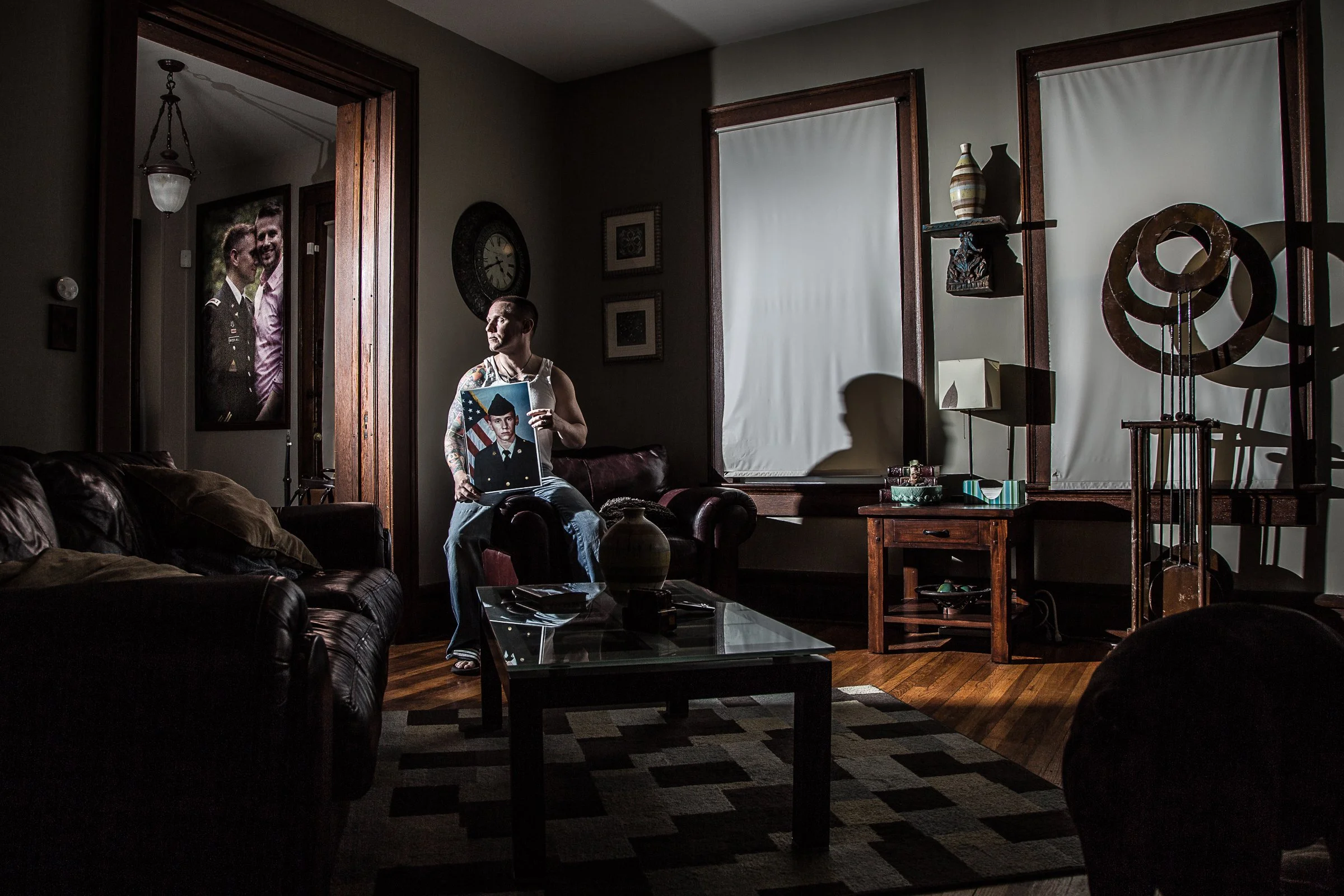
Steven Snyder-Hill
Survey #44 | Major, United States Army Reserve (Retired)
Steven Snyder-Hill joined the United States Army in 1988, beginning a military career that would eventually place him at the intersection of two defining struggles: serving his country and securing the right to serve openly as a gay man. His experiences would take him from the Persian Gulf War to Iraq, and from years of concealing his personal life to becoming a nationally recognized advocate for equality within the armed forces. Throughout those years, he maintained a commitment to military service even when the institution he served required him to hide an essential part of who he was.
Snyder-Hill's early military service included deployment to the Persian Gulf during Operation Desert Storm. The experience exposed him to the realities of warfare and the uncertainty that accompanies military operations. Among the events that remained with him was an incident involving friendly artillery fire, a reminder that danger in combat does not always come from the enemy. His military experience would become an important part of his identity, shaping his understanding of responsibility, discipline, and the relationships formed among soldiers who depend upon one another.
As he began to understand and acknowledge his sexual orientation, Snyder-Hill faced a conflict between his personal identity and the expectations of military life. At a time when openly gay service members faced exclusion, he had to consider what honesty about his life might mean for his future in uniform. His eventual decision to come out in his personal life was an important step, but it did not eliminate the restrictions imposed by military policy. The freedom to acknowledge who he was outside the military did not extend to the institution in which he had chosen to serve.
During a visit to Dachau, the former Nazi concentration camp in Germany, Snyder-Hill encountered the history of people persecuted because of their sexual orientation. The pink triangle, used by the Nazis to identify men imprisoned for homosexuality, became particularly meaningful to him. The experience connected his own questions about identity and acceptance with a much larger history of discrimination and persecution. Although the circumstances were profoundly different, the encounter reinforced his awareness of what can happen when institutions define certain people as unworthy of equal treatment.
In March 2001, Snyder-Hill reenlisted in the Army, choosing to continue serving under the policy known as Don't Ask, Don't Tell. The policy prohibited openly gay, lesbian, and bisexual people from serving while allowing them to remain in uniform if they concealed their sexual orientation. For Snyder-Hill, reenlistment meant accepting that his professional commitment would require a degree of personal secrecy. He believed in military service and wanted to continue contributing, even though the conditions of that service prevented him from being fully open about his life.
The restrictions affected more than conversations with colleagues. They shaped how Snyder-Hill approached friendships, relationships, and the ordinary details of daily life. Information that heterosexual service members could share without concern became potentially dangerous for someone in his position. The need to conceal a relationship or avoid revealing too much about his personal life created a division between the soldier his colleagues knew and the person he was outside the military. That division required constant awareness, particularly as his responsibilities increased and his relationships became more significant.
Snyder-Hill eventually met Josh, who would become his husband. Their relationship developed while the military's restrictions on openly gay service members remained in force, requiring Snyder-Hill to navigate the difference between the life he wanted to build and the life he could safely acknowledge in uniform. Their partnership became an important source of stability and support, but it also highlighted the unequal treatment of military families. While other service members could speak openly about their spouses and partners, Snyder-Hill had to consider the possible consequences of acknowledging the person closest to him.
His military career also took him to Iraq, where he served during a period of prolonged American military operations. The deployment reinforced the contradiction he had lived with for years. He was trusted to fulfill his responsibilities as a soldier, serve alongside other Americans, and accept the risks associated with military duty, yet he remained subject to a policy that treated his sexual orientation as grounds for exclusion if openly acknowledged. For Snyder-Hill, the issue was not whether gay Americans were willing or able to serve. They were already serving, often with distinction. The question was whether they would be permitted to do so without concealing their identities.
As the national debate over Don't Ask, Don't Tell intensified, Snyder-Hill became increasingly willing to challenge the assumptions underlying the policy. He understood the military as an institution built upon standards of conduct, responsibility, and service. He questioned why those standards should be applied differently because of a person's sexual orientation. His position was grounded in his experience as a soldier who had already demonstrated his willingness to serve, rather than in a desire to stand apart from his fellow service members.
The repeal of Don't Ask, Don't Tell in September 2011 marked a historic change for the armed forces and a personal turning point for Snyder-Hill. The end of the policy meant that gay service members could acknowledge their identities without automatically placing their military careers at risk. Yet the public debate surrounding repeal also revealed how deeply divided Americans remained over the place of gay men and women in military life. Snyder-Hill found himself drawn into that debate in a way that would make his experience visible to a national audience.
During a nationally televised political debate in 2011, Snyder-Hill appeared by video from Iraq and asked a question about the continuing service of gay and lesbian Americans in the military. His appearance became a widely discussed moment because of the audience's reaction and the response from the stage. What might otherwise have been a question about military policy became a public demonstration of the attitudes that gay service members had confronted for years. Snyder-Hill was not speaking as an outside observer. He was an American soldier serving overseas, asking whether people like him would continue to be treated as less deserving of equal protection and respect.
The attention surrounding the debate transformed Snyder-Hill from a soldier whose personal life had long required discretion into a public figure associated with the struggle for military equality. He and Josh became involved in advocacy and public discussions about the experiences of gay service members and their families. Their visibility carried responsibilities of its own, particularly because the national conversation often reduced complex personal experiences to political arguments. Snyder-Hill's account offered a different perspective: the experience of someone who loved military service, believed in the institution, and wanted it to recognize the people already serving within it.
Snyder-Hill and Josh later married in a ceremony held at the grave of Leonard Matlovich, a decorated Air Force veteran who had publicly challenged the military's exclusion of gay service members during the 1970s. Matlovich had become one of the most recognizable figures in the earlier struggle for equality in the armed forces. His grave, marked by a memorial acknowledging his service and his identity as a gay veteran, provided a setting that connected Snyder-Hill and Josh's marriage to the history of those who had challenged military discrimination before them.
The choice of location gave their marriage a significance beyond the ceremony itself. Matlovich had risked his career by refusing to conceal his identity, helping make visible a conflict that would continue for decades. Snyder-Hill belonged to a later generation of service members who had lived through the restrictions Matlovich opposed and witnessed their eventual repeal. By marrying at his grave, Snyder-Hill and Josh acknowledged the sacrifices of earlier advocates while celebrating a personal freedom that had once seemed unattainable for many military couples.
The changes in military policy did not resolve every question of equality for Snyder-Hill and Josh. Recognition of same-sex marriages, access to benefits, and the legal standing of military spouses remained part of a broader national struggle. Their advocacy therefore extended beyond the right to serve openly. It concerned whether the families of gay and lesbian service members would receive the same acknowledgment, protections, and support available to other military families. For Snyder-Hill, the distinction mattered because military service affects not only the person wearing the uniform but also the people who share the responsibilities and sacrifices of that service.
His public advocacy was closely connected to his understanding of citizenship. Snyder-Hill had served in wartime and accepted the obligations that came with military service. He believed those obligations should be accompanied by equal treatment under the law. His experience challenged the idea that military service and gay identity were somehow incompatible. He had lived both identities throughout his career, including during periods when he was required to keep them separate in public.
Over time, Snyder-Hill's story became part of a larger historical transition in the American armed forces. He had entered military service during an era when openly gay Americans were excluded, reenlisted under Don't Ask, Don't Tell, served in Iraq while the policy remained in effect, and witnessed its repeal. Each stage of that experience reflected a different relationship between the military and the people it permitted to serve. His career provided a firsthand perspective on how institutional rules shape individual lives and how changes in those rules can alter the meaning of service and belonging.
The years of concealment also left questions that policy changes alone could not answer. A soldier who has spent years protecting personal information must adjust to the possibility of speaking freely about relationships and family. The transition from secrecy to openness involves more than permission; it requires rebuilding habits formed under the threat of professional consequences. Snyder-Hill's experience illustrated the personal costs of a policy that required service members to maintain separate public and private identities, even when their work and conduct met the standards expected of every other soldier.
Throughout his military career and subsequent advocacy, Snyder-Hill's commitment to service remained central to his story. He did not regard the struggle for equality as separate from his responsibilities as a soldier. Rather, he understood it as part of a broader commitment to the principles the military was intended to defend. His willingness to speak publicly grew from the belief that the institution could uphold its standards while treating service members and their families with greater fairness.
Steven Snyder-Hill's story encompasses two forms of service. One took place in uniform, through military assignments, deployments, and the responsibilities of an Army officer. The other emerged through his willingness to challenge policies that had forced him and others to conceal their identities. Both required commitment, and both shaped the life he built with Josh. His experience demonstrates that a person's dedication to military service can endure even when the institution has not fully recognized that person's place within it.
For Snyder-Hill, the end of Don't Ask, Don't Tell represented more than a change in regulations. It meant that the personal life he had once been required to conceal could finally be acknowledged alongside his military service. His marriage, his public advocacy, and his years in uniform became parts of a single story rather than separate identities that had to be carefully maintained. In documenting that experience, Conduct Becoming preserves the perspective of a veteran whose career spanned a profound change in the meaning of equality within the United States military.